November 11, 2026 · CutClub Team
8 Low-Effort Team Building Activities for Busy Teams
Short on time? Try these 8 low-effort team building activities that need little planning, from quick games to simple ways to connect with coworkers.

8 Low-Effort Team Building Activities for Busy Teams
Nobody wants another task disguised as team building.
Especially when the calendar is already full, deadlines are approaching, and someone has just scheduled a meeting to prepare for another meeting.
The problem with a lot of team building activities is not that people dislike spending time with their coworkers. It is that the activities require too much planning, too much coordination, or too much enthusiasm on command.
Good team bonding does not have to be complicated.
Sometimes all you need is a question, a little friendly competition, or a reason to talk about something other than work.
Here are eight low-effort team building activities that are easy to organize and do not require an entire afternoon.
1. The One-Question Debate
Time needed: 5 minutes
Planning required: Almost none
Start with a question that has no objectively correct answer but plenty of room for strong opinions.
For example:
- Is breakfast food better at dinner?
- What's the most overrated movie?
- Which office snack deserves to be banned?
- What's the best way to spend a three-day weekend?
- Would you rather have unlimited vacation days or a four-day workweek?
Let people pick a side and defend their answer.
You can do this at the beginning of an existing meeting, in a group chat, or over lunch.
The trick is to avoid questions that sound like corporate icebreakers.
"What's your greatest professional strength?" is an interview question.
"Which fictional character would be the worst coworker?" is a conversation.
2. The One-Song Music Challenge
Time needed: A few minutes to submit, plus listening and voting time
Planning required: Low
Everyone has music opinions. You just need a theme that gives them something to argue about.
Pick a prompt and ask everyone to submit one song.
Try:
- The song that gets you through a Monday
- Best song for a dramatic entrance
- A song everyone should hear at least once
- Your most controversial music opinion, expressed through one track
- The song you'd play after finishing a huge project
Once the songs are in, everyone listens and votes for their favorite.
The winning song gets bragging rights.
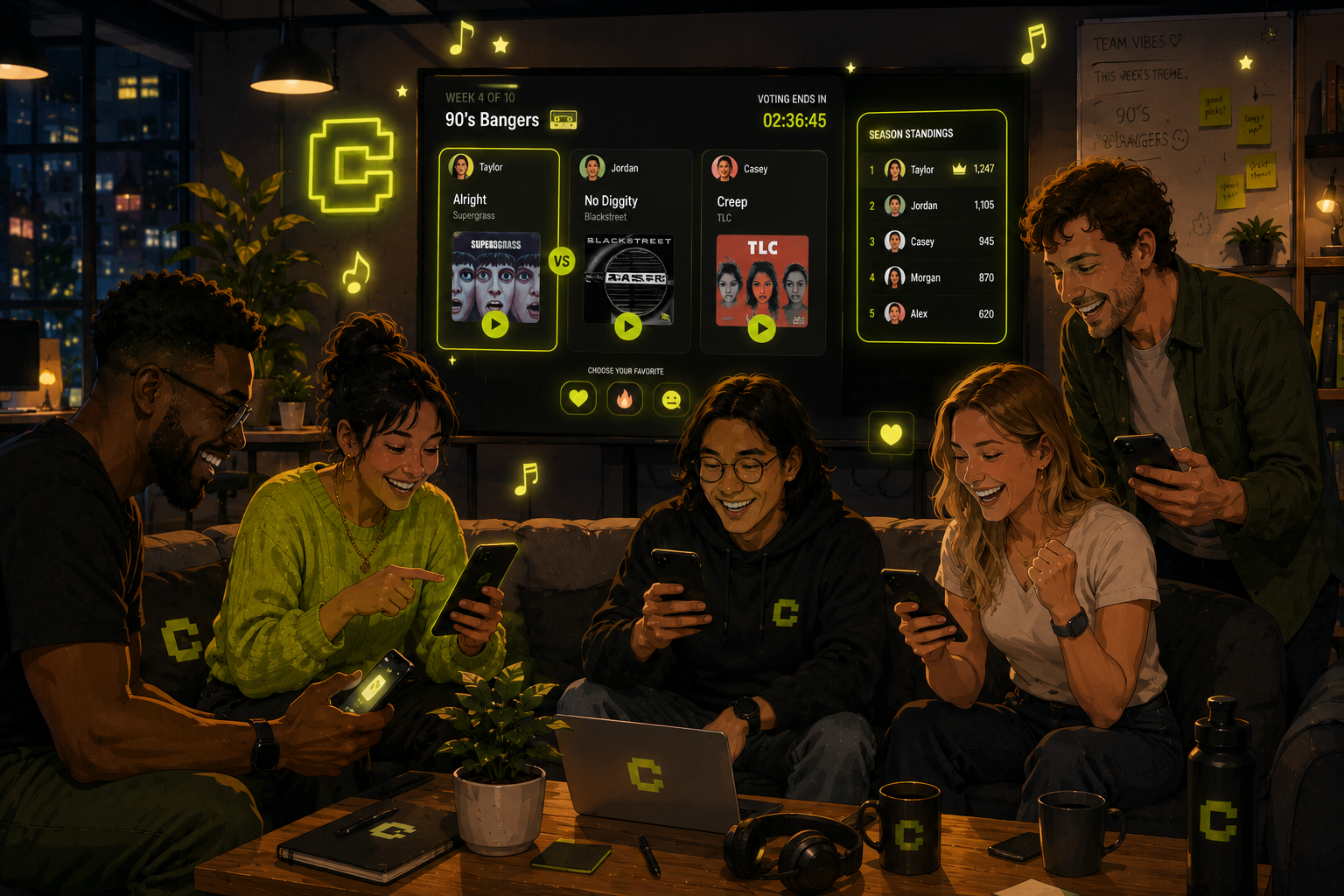
You can organize a single challenge in your team chat, or use Cut Club if you want to turn it into a recurring competition.
Cut Club is a season-based music game where coworkers submit songs to themed matchups, listen, vote, and compete for points. The standings build across the season until one player becomes champion.
It works especially well for busy teams because people can participate during the submission and voting windows instead of attending another live activity.
And you might finally discover what your coworkers listen to when nobody else controls the speakers.
3. The Desk Object Story
Time needed: 5 to 10 minutes
Planning required: None
Ask everyone to find one interesting object on their desk or in their workspace.
Then give them 30 seconds to explain why they have it.
It could be:
- A souvenir from a trip
- A strange gift
- An old photograph
- A favorite mug
- A completely unnecessary gadget
- Something they have owned for years
The object gives people a natural starting point for a story.
And unlike traditional introductions, nobody has to invent something interesting about themselves on the spot.
For remote coworkers, this can work through photos and short messages instead.
4. The Five-Minute Recommendation Swap
Time needed: 5 minutes
Planning required: None
Ask everyone to recommend one thing they genuinely enjoyed recently.
It can be anything.
A restaurant. A podcast. A book. A game. A recipe. A movie. A place to visit.
The only rule is that they have to explain why someone else should try it.
You can rotate the category each week or leave it completely open.
This is an easy team bonding activity because people get to share something personal without feeling pressured to reveal anything too private.
It also creates conversations that can continue long after the activity ends.
Someone tries a recommendation.
They report back.
Another person disagrees.
Now you have a conversation that did not begin with a project update.
5. The Two-Minute Prediction Game
Time needed: 2 minutes to predict, plus a later reveal
Planning required: Very little
Give everyone something to predict.
It could be:
- Which movie will win an upcoming award?
- What will be the most popular office lunch order this week?
- Which team will win a major sporting event?
- How many coffees will the office consume on Friday?
- What will be the first song played at the company party?
Collect the predictions in a shared document or group chat.
When the answer becomes known, reveal who got closest.
You can keep a running scoreboard if your coworkers get competitive.
Or simply enjoy the fact that someone was extremely confident and completely wrong.
Keep the predictions light. Nobody needs another performance metric.
6. The Tiny Team Trivia Round
Time needed: 5 to 10 minutes
Planning required: 5 minutes
Forget the hour-long trivia night with complicated rules and 60 questions.
Pick five questions.
That's it.
You can choose a different topic each time:
- Movies and television
- Music
- Food
- Geography
- Sports
- Random facts
- Pop culture
Read the questions aloud during an existing team gathering or post them in a chat.
People answer individually or in small groups.
Reveal the answers, declare a winner, and move on.
The short format keeps trivia from turning into a major event.
It also means you can repeat it occasionally without needing a dedicated organizer or a complicated schedule.
7. The Anonymous Fun Fact Challenge
Time needed: 10 minutes
Planning required: A few minutes to collect answers
Ask each coworker to send you one surprising but harmless fact about themselves.
For example:
- I've appeared on television.
- I've visited more than 20 countries.
- I once met a famous musician.
- I can solve a Rubik's Cube.
- I used to compete in a completely unexpected sport.
Put the facts into a list without names.
Then ask everyone to guess who each fact belongs to.
Once the guesses are in, reveal the answers.
The best part is usually the stories that follow.
Just make sure people can choose what they share. Nobody should feel obligated to reveal personal information to participate.
8. The Friday Win and Wildcard
Time needed: 5 minutes
Planning required: None
End the week with two simple questions:
- What's one thing that went well this week?
- What's one completely unrelated thing you want to share?
The first question gives people a chance to recognize progress.
The second keeps the activity from becoming another status update.
The wildcard could be a funny photo, a song, a recommendation, a personal achievement, or something interesting they learned.
You can run it during the last few minutes of an existing meeting or as a recurring chat thread.
There is no winner, no complicated setup, and no pressure to prepare.
Just a small opportunity to end the week on something other than a deadline.
What Makes a Team Building Activity Actually Low-Effort?
An activity is not low-effort just because it takes five minutes.
If someone has to spend two hours organizing those five minutes, you have missed the point.
The best easy team building ideas share a few characteristics.
They need almost no preparation
You should be able to explain the activity in one or two sentences.
If you need a presentation, a detailed instruction document, and three reminder emails, choose something simpler.
They fit into the workday
Not every activity needs its own calendar invite.
A quick question can fit into an existing meeting. A recommendation thread can live in your team chat. A music challenge can stay open while everyone gets on with their work.
The less disruption, the easier it is to participate.
They don't require everyone to be outgoing
Some coworkers love performing in front of a group.
Others would rather do almost anything else.
Choose activities where people can contribute without becoming the center of attention.
Voting, guessing, recommending, and submitting ideas all give quieter team members ways to participate.
They create something to talk about afterward
A good team building activity does not need to end the moment the game finishes.
A surprising answer, an unexpected winner, or a particularly controversial song choice can give coworkers something to reference later.
Those small shared moments are often more useful than an elaborate one-time event.
They're easy to repeat
You do not need eight completely new activities every month.
Find one or two formats your team enjoys and bring them back.
Change the question.
Pick a new trivia category.
Run another music challenge.
Keep what works.
How Often Should You Do Team Building Activities?
There is no perfect schedule.
A busy team probably does not need a new activity every day.
Start with something small once a week or every couple of weeks. See whether people participate and whether the activity creates conversation.
If it feels like another obligation, make it shorter or less frequent.
If people start asking when the next round is happening, you have probably found something worth keeping.
The goal is not to fill everyone's calendar with fun.
It is to give people a few more reasons to connect while they are already working together.
Keep the Activity Simple. Let the Fun Build.
The best team building activities do not need an event planner, a big budget, or a room full of enthusiastic volunteers.
They need a good prompt and people willing to play along.
Start with a five-minute debate. Try a recommendation swap. Ask a ridiculous trivia question.
Or give your coworkers a music challenge and find out who has been quietly hiding the best taste in the office.
If your team enjoys the music format, Cut Club lets you keep the competition going with themed matchups, voting, and season standings.
Every new club gets a free trial season with two matchups, so you can try the format with your coworkers before deciding whether to run a longer season.
No awkward icebreakers required.
Cut Club
Play with your people.
Weekly themes, one song per matchup, votes, banter, recaps. Bring your group.
Related posts
Aug 3, 2026 · CutClub Team
15 Team Building Music Games Your Team Will Actually Enjoy in 2026
Looking for team building music games your team will actually enjoy? Discover 15 fun activities for remote teams, office events, and company socials that bring people together through music.
#team-building #workplace #remote-teams

Oct 19, 2026 · CutClub Team
10 Office Music Challenge Ideas for Teams and Coworkers
Try these 10 office music challenges for coworkers, from song battles and guessing games to an ongoing team music competition.
#workplace #music-challenges #team-building

Oct 5, 2026 · CutClub Team
Remote Team Building Without Another Zoom Meeting: 10 Async Activities That Actually Work
Looking for remote team building without another Zoom call? Try these 10 async team activities designed for distributed teams and different time zones.
#remote-team-building #async-team-building #remote-teams