September 28, 2026 · CutClub Team
How to Run a Music League at Work Without Making It Feel Like Forced Fun
Want to start a music league at work without another awkward team-building exercise? Here’s how to keep it low-pressure, competitive, and actually fun.

Nobody wants another mandatory fun activity.
You know the kind.
A calendar invite appears. Someone has prepared an icebreaker. Everyone is told to bring their "best energy." Half the team is wondering whether they can claim a scheduling conflict.
A workplace music league can feel completely different.
Instead of putting everyone on a call and asking them to perform being social, give the team a simple recurring competition: one theme, one song, a vote, and a scoreboard.
People participate when they have time. The music gives them something natural to talk about. And after a few rounds, the standings start doing some of the work for you.
Here's how to run one without becoming the coworker who takes team building way too seriously.
1. Make participation optional
Start here.
The fastest way to ruin a social activity is to make everyone participate.
Invite the team. Explain the idea. Let the people who are interested join.
You don't need every person in the company to make a music league work. A smaller group of people who genuinely want to play will create more energy than a giant group of reluctant participants.
If other coworkers see people talking about the themes, debating the results, or celebrating a ridiculous win, they can always join another season later.
Interest beats obligation.
2. Keep the commitment small
Your coworkers already have jobs.
Don't give them another one.
A good workplace music competition should require very little from each player. Give everyone a theme and ask them to submit one song.
That's it.
No presentation. No playlist with 15 recommendations. No five-paragraph explanation of why an obscure B-side changed their life.
One song keeps the decision meaningful without turning the activity into homework.
Then give people enough time to listen and vote when it fits their schedule.
3. Pick themes anyone can answer
You might have one coworker who knows every underground release from the last decade and another who has been listening to the same Fleetwood Mac album since 2014.
Both should be able to play.
Avoid building every round around music trivia or niche genre knowledge. Use themes that reward interpretation and personality instead.
Try:
- A song that instantly improves your mood
- Your perfect Friday afternoon song
- A song for getting something done at the last possible minute
- A song that belongs in a movie trailer
- A song you know every word to
- The song you'd play if you controlled the office aux
- A song that reminds you of being a teenager
- A song everyone should hear once
Good themes give people a way in regardless of how much music they know.
The music nerd can still dig deep. Everyone else can still compete.
4. Don't turn it into a meeting
Your music league does not need a weekly 30-minute sync.
Please do not create one.
The advantage of a recurring music competition is that most of it can happen asynchronously.
Post the theme. Let people submit. Give them time to listen. Open voting. Share the results.
Slack, Discord, or whatever your team already uses can handle the conversation around it.
If people start discussing a submission on their own, great. That's the point.
The activity should create conversation, not require a meeting in order for conversation to happen.
5. Give people enough time to actually listen
A workplace music league shouldn't compete with someone's Tuesday deadline.
Build the game around the reality that people have different schedules, workloads, and time zones.
Don't expect everyone to submit immediately after a theme drops. Don't give them a tiny voting window. And don't chase someone down because they haven't listened yet.
The competition should add something fun to the workweek, not another notification that makes people feel behind.
A predictable rhythm helps.
When people know when themes, submissions, voting, and results usually happen, participating becomes easier.
6. Let the competition create the conversation
You don't need a list of discussion questions.
The submissions will handle that.
"Who submitted this?"
"There is no way this fits the theme."
"I haven't heard this song in ten years."
"How is mine losing?"
That's a much easier starting point than asking everyone to share a fun fact about themselves.
Music gives people something specific to react to without demanding that they immediately get personal.
Over time, the songs reveal plenty anyway.
You learn who has suspiciously strong knowledge of 2000s pop. Who keeps submitting six-minute songs. Who takes every theme literally. Who has been hiding an excellent collection of deep cuts.
The social part happens around the game.
You don't have to manufacture it.
7. Keep the rivalry friendly
A scoreboard makes things more interesting.
It also means someone is going to discover that their coworkers do not respect their music taste nearly as much as expected.
Keep the trash talk aimed at the game.
Roast the submission. Question the interpretation. Call out the questionable voting. Keep receipts when someone claims they were robbed.
Don't turn someone's actual taste, background, age, or identity into the joke.
The goal is low-stakes rivalry.
You want people trying to win without anyone feeling like they need to be a music expert to belong.
8. Let the standings build over time
One round is a fun diversion.
A season creates a story.
When points carry across multiple rounds, people start paying attention to more than the individual winner.
Someone starts 0-2 and makes a comeback.
The person who claimed they "weren't competitive" suddenly knows exactly how many points separate them from first.
Two coworkers develop a completely unnecessary rivalry over second place.
That continuity is what makes a music league work well as a recurring team activity.
You're not inventing something new every week. You're continuing something people already understand.
9. Give it an ending
Recurring does not have to mean endless.
In fact, it probably shouldn't.
Give your music league a defined season. Let the standings build. Finish with a final round. Crown a champion.
Then stop.
That ending gives the competition some stakes and gives everyone a natural break.
If the team wants another season, run it back with new themes.
If they don't, you still had a complete activity instead of another workplace initiative that quietly disappeared after week four.
10. Don't over-manage the fun
This is the big one.
You don't need constant reminders, elaborate prizes, themed Zoom backgrounds, a kickoff presentation, or an official company-wide announcement.
Give people the structure they need to play and then get out of the way.
The best sign that your music league is working isn't 100% participation.
It's someone bringing up a song from the competition when nobody from People Ops is around.
Or someone protesting last week's results in an unrelated Slack thread.
Or the person in fifth quietly announcing that they're making a comeback.
That's a team ritual.
A simple format for your first workplace music league
If you're organizing one for the first time, keep the setup simple:
- Invite coworkers who actually want to play.
- Choose a defined season rather than an endless competition.
- Give the group one theme per round.
- Let everyone submit one song.
- Give people time to listen.
- Vote.
- Update the standings.
- Repeat until you crown a champion.
The organizer's job should mostly be keeping the rhythm moving.
Not running entertainment programming for the office.
Let Cut Club handle the competition
You can run this manually with forms, spreadsheets, messages, and a willingness to keep track of everything yourself.
But that starts to defeat the "low effort" part.
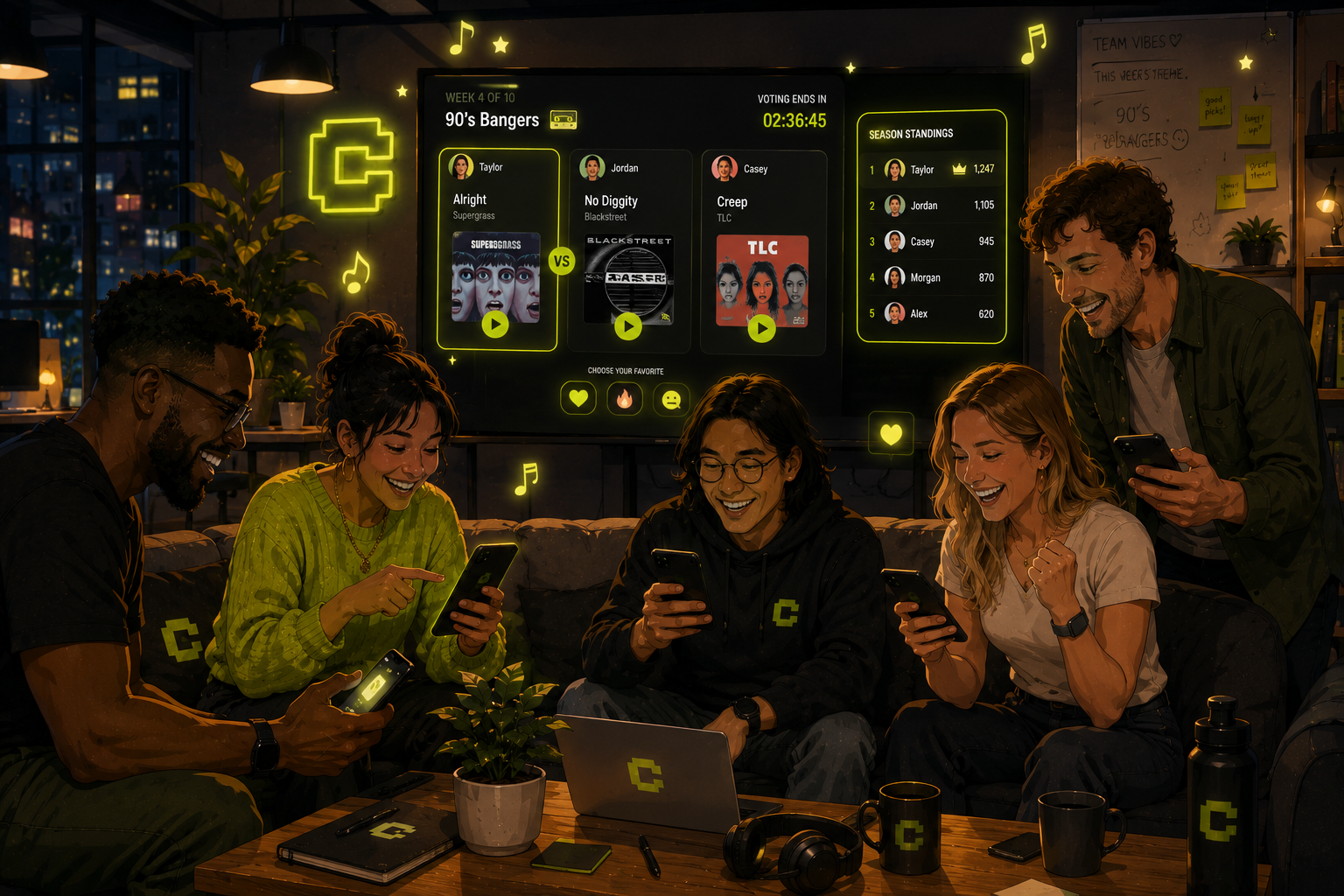
Cut Club is a season-based music game built around recurring competition. Players submit one song to themed matchups, vote on the picks, earn points, and compete across a season until a champion is crowned.
For a workplace group, that means the structure is already there.
You get the themes, submissions, voting, standings, and season arc without turning one coworker into the full-time administrator of everyone's music opinions.
The competition gives the team a reason to keep coming back.
The songs give them something to talk about.
And nobody has to attend another virtual happy hour.
That's a win before the votes are even counted.
Cut Club
Play with your people.
Weekly themes, one song per matchup, votes, banter, recaps. Bring your group.
Related posts

Sep 21, 2026 · CutClub Team
20 Music Competition Themes That Lead to Great Song Picks
Need a theme for your next music competition? Try these 20 song challenge prompts built for better picks, new discoveries, and plenty of debate.
#music-themes #music-games #music-competition

Sep 14, 2026 · CutClub Team
How to Start a Music Competition With Your Friends
Learn how to start a music competition with friends, from choosing themes and submitting songs to voting, scoring, and keeping everyone engaged.
#music-games #music-competition #friends
Aug 3, 2026 · CutClub Team
15 Team Building Music Games Your Team Will Actually Enjoy in 2026
Looking for team building music games your team will actually enjoy? Discover 15 fun activities for remote teams, office events, and company socials that bring people together through music.
#team-building #workplace #remote-teams